
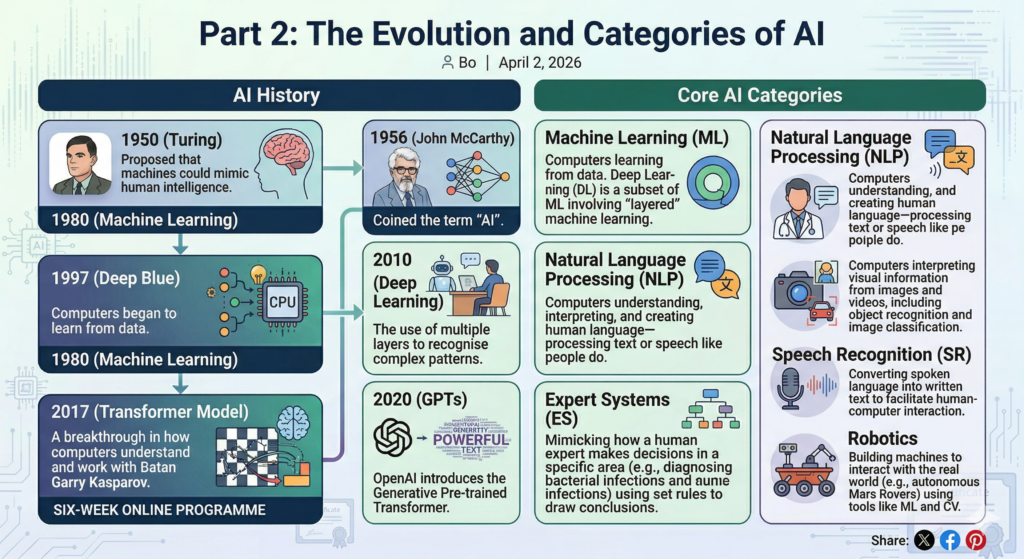
A Timeline of AI History
- 1950 (Turing): Proposed that machines could mimic human intelligence.
- 1956 (John McCarthy): Coined the term “AI.”
- 1980 (Machine Learning): Computers began to learn from data.
- 1997 (Deep Blue): A computer defeats chess grandmaster Garry Kasparov.
- 2010 (Deep Learning): The use of multiple layers to recognise complex patterns.
- 2013: A machine finally passes the Turing test.
- 2017 (Transformer Model): A breakthrough in how computers understand and work with human language by capturing the relationships between different words.
- 2020 (GPTs): OpenAI introduces the Generative Pre-trained Transformer.
Core AI Categories
AI is divided into several functional disciplines:
- Machine Learning (ML): Computers learning from data. Deep Learning (DL) is a subset of ML involving “layered” machine learning.
- Natural Language Processing (NLP): Computers understanding, interpreting, and creating human language—processing text or speech like people do.
- Expert Systems (ES): Mimicking how a human expert makes decisions in a specific area (e.g., diagnosing bacterial infections) using set rules to draw conclusions.
- Computer Vision (CV): Computers interpreting visual information from images and videos, including object recognition and image classification.
- Speech Recognition (SR): Converting spoken language into written text to facilitate human-computer interaction.
- Robotics: Building machines to interact with the real world (e.g., autonomous Mars Rovers) using tools like ML and CV.